
If you run a business in HoReCa, food processing or retail, few decisions will impact your long-term profitability more than choosing the right commercial refrigeration system.
A correctly chosen system works invisibly in the background — maintaining temperatures, protecting stock and consuming energy efficiently. A poorly chosen system quickly becomes one of the most expensive operational mistakes you can make: inflated energy bills, spoiled goods, breakdowns at the worst possible moment, and remediation costs that far exceed the initial savings made at purchase.
Demand for the modernisation of commercial refrigeration systems grew by 40% in the first months of 2026, and one of the main reasons is that many businesses are operating with equipment that is undersized or incorrectly designed for their actual needs. This guide is here to make sure you don't make the same mistake.
1. First Step: Identify Your Application Type and Required Temperature
Before any discussion about equipment or budgets, you need to know exactly what you want to refrigerate and at what temperatures. Commercial refrigeration systems fall into three main categories:
Positive refrigeration (+2°C to +8°C) — for dairy products, beverages, fruit and vegetables, ready-to-eat meals and pastry products. Typical for restaurants, cafés, supermarkets and food distribution warehouses.
Negative refrigeration (−18°C and below) — for meat, fish, seafood, frozen products and ingredients requiring long-term preservation. Requires more powerful compressors and superior insulation.
Process refrigeration — specific to the food industry, abattoirs and processing plants, where temperature and humidity must be controlled simultaneously with high precision throughout a continuous production flow.
Each category demands different equipment, refrigerants and configurations. An installation sized for a beverage storage room will not perform correctly if repurposed for rapid meat freezing — and vice versa.
2. Calculate the Thermal Load Correctly — Don't Underestimate This Step
The thermal load is the amount of heat the system must continuously extract to maintain the desired temperature in the cooled space. It is the most technical — and most frequently miscalculated — step in the process of selecting a refrigeration system.
Thermal load depends on several simultaneous factors:
The dimensions and insulation quality of the space (panel thickness, door type, presence of gaps or penetrations)
The quantity and type of products introduced daily (warm products placed in the space generate additional thermal load)
Door opening frequency and staff traffic
Ambient temperature of the room where the outdoor unit is installed
Internal heat sources: lighting, fan motors, adjacent equipment
An underestimated calculation results in a permanently overloaded system — one that will fail to reach and maintain temperature on hot summer days, consume excessive energy and wear out prematurely. An overestimated calculation means an unjustified investment and frequent compressor start-stop cycles, which degrade mechanical components over time.
Our recommendation: always request a technical assessment carried out by a specialist before purchasing. At InterFrig Group, we offer free technical consultation for the correct sizing of any refrigeration system.
3. Choose the Right Equipment for Your Type of Business
Solutions differ significantly depending on your sector. Here is what equipment is appropriate for each context:
Restaurants and cafés
Display refrigeration cabinets, under-counter fridges for food preparation, cold rooms for raw material storage. Priorities are compact dimensions, low noise levels and high reliability under intensive use conditions.
Supermarkets and food retail
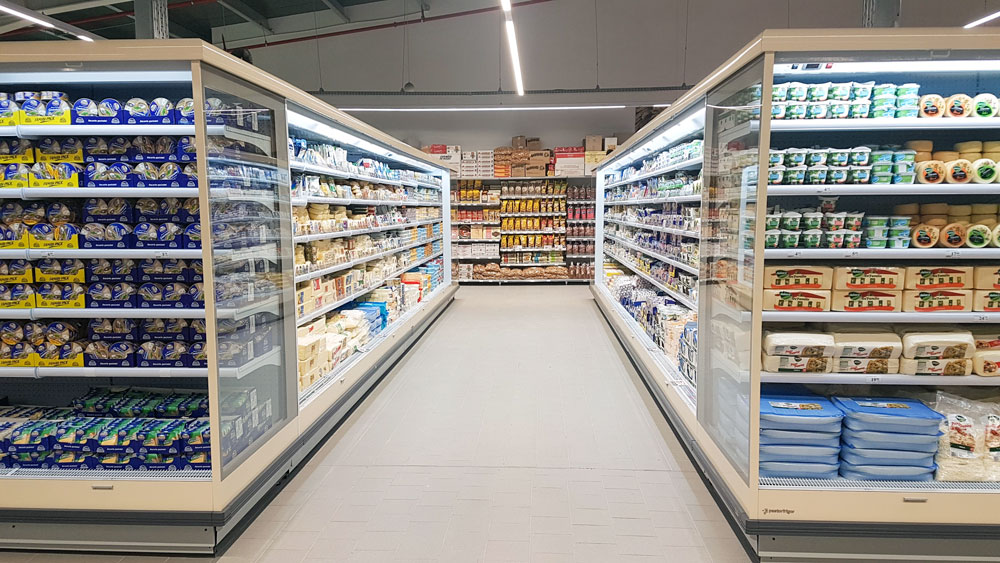
Open or closed refrigerated display units for the sales floor, multi-circuit central refrigeration systems with expansion capability, real-time temperature monitoring. Refrigeration systems can account for between 30% and 60% of a store's total energy consumption — energy efficiency becomes a decisive factor here.
Hotels and catering operations
Centralised systems with multiple independent temperature zones, high reliability, low noise and easy integration with the building's infrastructure.
Abattoirs and meat processing plants
Large-capacity cold rooms, rapid freezing tunnels (blast chillers), precise relative humidity control, HACCP-compatible systems. Veterinary sanitary regulations impose very strict conditions that equipment must meet by design, not through improvisation.
Logistics and food warehouses
Industrial systems with high-capacity compressors, built-in redundancy (a minimum of two independent circuits for operational continuity), remote alarm and monitoring systems.
4. Verify Component Quality — Don't Focus Only on the Unit Price
The performance and durability of a refrigeration system are directly proportional to the quality of its components. When requesting a quote or reviewing a technical specification, check which brands are used for the critical components:
Compressors — Bitzer and Danfoss are global reference standards in the refrigeration industry, recognised for superior energy efficiency and long service life. An inferior-quality compressor may seem like an upfront saving but can prove extremely costly over time.
Electronic regulators and controllers — Danfoss provides control and automation solutions that optimise energy consumption and enable remote monitoring, essential for operators managing multiple locations.
Refrigeration and cooling systems for commercial applications — Trane and Samsung cover a wide range of solutions tested in demanding commercial and industrial environments.
Valves, separators and automation elements — Emerson guarantees safe operation, sealing integrity and long-term performance throughout the entire refrigeration circuit.
A system built from certified components by reputable manufacturers costs more at the point of purchase. The difference is recovered within 2–3 years through reduced energy consumption, less frequent maintenance and the absence of costly breakdowns.
5. Energy Efficiency — The Most Important Long-Term Factor
Commercial refrigeration systems operate 24 hours a day, 365 days a year. The difference between average-efficiency and high-efficiency equipment can translate into tens of thousands of lei over the system's operational lifetime.
The key indicator is the COP (Coefficient of Performance) — the ratio between refrigerating capacity produced and electrical energy consumed. The higher the COP, the more efficient the system. Always request technical data sheets and compare the COP at your actual operating conditions, not just the nominal laboratory conditions (which are always more favourable).
Inverter-driven compressors (variable frequency drive) represent one of the most significant innovations in commercial refrigeration today. Unlike conventional compressors that start and stop at full power, inverter compressors continuously adjust output to match the actual thermal load — eliminating unnecessary consumption during low-demand periods and significantly extending the service life of mechanical components.
Interest in the adoption of modern technologies grew by 35% in 2026, particularly for CO₂-based systems and real-time monitoring solutions — proof that the market has understood that energy efficiency is no longer an optional advantage, but an economic necessity. Revista Biz
6. Refrigerants and F-Gas Regulatory Compliance
One aspect frequently overlooked at the purchasing stage is the type of refrigerant used and its legal and economic implications over the long term.
The European F-Gas Regulation (EU Regulation 517/2014 and subsequent revisions) progressively restricts the use of refrigerants with a high global warming potential (high GWP), such as R-404A or R-507. Many operators discover too late that the equipment they purchased uses refrigerants whose prices have risen sharply or which are scheduled to be phased out of the market entirely.
Make sure the system you purchase uses refrigerants that comply with current and future regulations: R-448A, R-449A, R-452A or, for large-capacity industrial applications, transcritical CO₂ — the solution with the best long-term sustainability profile.
7. Plan Maintenance Before Installation, Not After the First Breakdown
A refrigeration system without a preventive maintenance plan is a system that will inevitably fail at the worst possible moment — in the middle of summer, around the holiday season or over a weekend, when emergency call-out costs are multiplied significantly.
Make sure your supplier can offer:
Rapid technical intervention in case of breakdown, with guaranteed response times written into the contract
Periodic maintenance contract — pressure checks, refrigerant top-up, condenser and evaporator cleaning, electrical component inspection
Spare parts available in local stock — a supplier who only orders parts from abroad after a breakdown occurs is not the right partner for an operation that cannot afford extended downtime
Certified technical personnel for refrigerant installations (F-Gas certification, and ISCIR authorisation where applicable)
Final Checklist Before You Decide
Before signing a contract or placing an order, make sure you can answer yes to all of the following:
- Has the actual thermal load been calculated, not just estimated?
- Is the application type and required temperature correctly identified?
- Are the key components (compressor, controller, valves) from reputable manufacturers?
- Have you verified the COP at your actual operating conditions?
- Is the refrigerant used compliant with current F-Gas regulations?
- Have you clarified the maintenance contract terms and response times?
- Does the supplier have proven experience in your specific sector?
Conclusion
Choosing a commercial refrigeration system is not a decision you can make based on the lowest price in a quote. It is an investment in the operational continuity of your business — and the cost of a wrong choice is paid out gradually, over months and years, through energy bills, breakdowns and stock losses.
With over 20 years of experience in the design, installation and servicing of industrial and commercial refrigeration systems across Constanța County and nationally, the InterFrig Group team offers free technical consultation to help you make the right decision from the very start.
Contact us for a free consultation:
office@interfrig-group.ro
+40 241 661 048
InterFrig Group — Industrial and commercial refrigeration solutions since 2005