
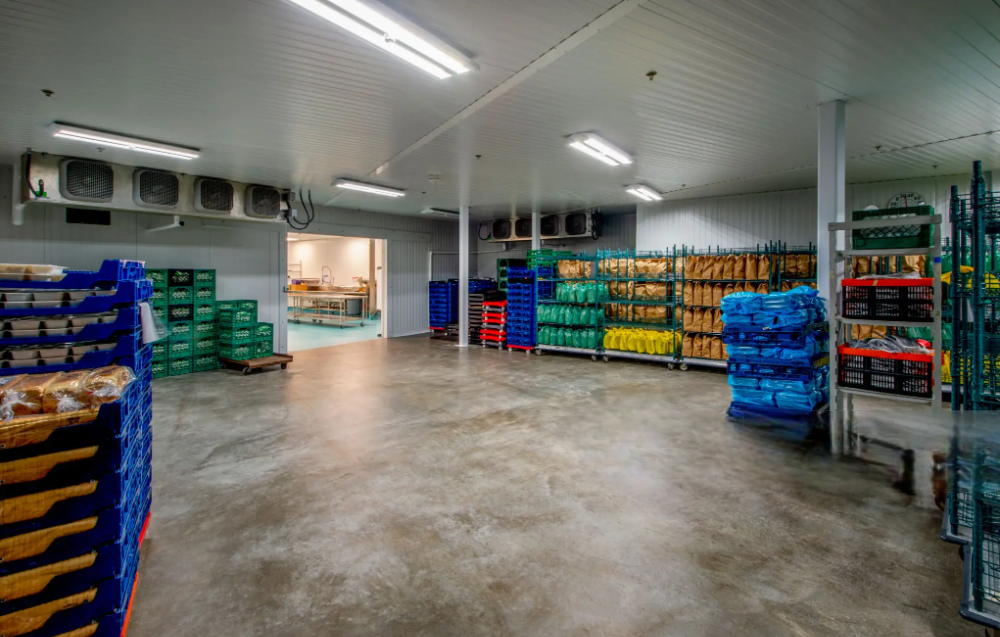
The difference between a cold storage warehouse sized correctly and one designed at the minimum acceptable level is not visible at project handover. It shows in the first year of operation — in the energy bill, in the frequency of failures, in product losses and in unexpected maintenance costs.
An industrial cold storage warehouse is an investment for 20-30 years. Decisions made at the design stage — the type of refrigeration system, insulation thickness, compressor capacity, level of automation — determine operating costs throughout this entire period. One euro saved incorrectly at construction can generate ten euros in additional operating costs.
What Is an Industrial Cold Storage Warehouse and When Do You Need One?
An industrial cold storage warehouse is a space built and equipped for storing food products or other temperature-sensitive goods at commercial or industrial scale. Unlike small cold storage rooms — intended for restaurants, shops or small producers — industrial warehouses are designed for large volumes, continuous operation and strict traceability and food safety requirements.
You need an industrial cold storage warehouse if:
You produce or process large quantities of food and cannot sell your entire production immediately after harvest or processing
You distribute food products and need buffer storage capacity between production and delivery
You operate a retail chain and need your own refrigerated distribution centre
You export food products and must comply with strict temperature and traceability requirements throughout the logistics chain
Types of Industrial Cold Storage Warehouses
Refrigerated Storage Warehouses
These operate at positive temperatures, between 0°C and +15°C, depending on the product stored. They are used for fresh meat (+2°C / +4°C), fresh fish (0°C / +2°C), dairy products (+2°C / +6°C), fruit and vegetables (+4°C / +12°C, depending on species) and bakery or confectionery products.
The design of a refrigerated storage warehouse must account for the required relative humidity — vegetable products require high humidity (85-95%), while meat products require controlled humidity to prevent both dehydration and bacterial growth.
Freezer Warehouses
These operate at negative temperatures, between -18°C and -30°C, for frozen products: meat, fish, processed fruit and vegetables, frozen bakery products, ice cream. Insulation requirements are significantly higher than for refrigerated warehouses — the thickness of insulated panels increases proportionally with the temperature difference from the exterior.
A critical aspect of freezer warehouses is the floor heating system, required to prevent freezing of the soil beneath the warehouse and degradation of the load-bearing structure. Omitting this element from the design generates serious structural problems over time.
Multi-Temperature Warehouses
Many industrial applications require zones with different temperatures in the same facility — a receiving area at positive temperature, a processing zone at +4°C / +8°C and a freezing zone at -18°C / -22°C. Designing these warehouses is more complex and requires correct thermal separations between zones, dedicated or separate-circuit refrigeration systems and advanced automation for independent control of each zone.
Controlled Atmosphere Storage Warehouses
Intended primarily for fruit and vegetables for long-term storage — apples, pears, kiwi, cabbage — controlled atmosphere warehouses reduce oxygen concentration and increase CO₂ concentration compared to normal atmospheric values, dramatically slowing ripening and degradation processes. Combined with controlled temperature and humidity, this system allows apples, for example, to be stored for 8-10 months with minimal losses.
Stages of Designing an Industrial Cold Storage Warehouse
Feasibility Study and Thermal Load Calculation
Every cold storage warehouse project begins with the thermal load calculation — the amount of heat that the refrigeration system must extract to maintain the desired temperature. This calculation includes:
Heat losses through walls, ceiling and floor — depending on insulation thickness and type
Cooling load of products introduced daily into the warehouse
Heat generated by lighting, electrical equipment and personnel working in the warehouse
Heat load from opening doors and loading-unloading docks
Respiration heat of live vegetable products — relevant for fruit and vegetables
A correct thermal load calculation prevents both oversizing — which increases initial cost and energy consumption — and undersizing, which generates inability to maintain temperature during peak periods.
Choosing the Refrigeration System
The refrigeration system of an industrial warehouse can be:
Direct expansion (DX): the refrigerant circulates directly in the evaporators inside the warehouse — a simple, efficient system for medium-sized warehouses
Glycol system: the refrigerant cools an intermediate agent (glycol), which then circulates through the warehouse — safer in food applications, easier to control temperature
Transcritical CO₂: the modern solution for large warehouses, with minimal GWP and excellent energy performance — increasingly adopted in Western Europe, with significant potential in Romania
The choice of refrigerant is a decision with impact throughout the entire lifespan of the installation. High-GWP refrigerants — R404A, R507 — are being phased out under European legislation, meaning installations designed today with these refrigerants will require conversion in the coming years.
Designing the Thermal Envelope
The thermal envelope — the walls, ceiling and floor of the warehouse — is the first line of defence against heat gain. Insulated sandwich panels used in cold storage warehouse construction have a core of rigid polyurethane or expanded polystyrene, with thicknesses calculated according to working temperature:
Refrigerated warehouses (0°C / +8°C): 80-100 mm panels
Freezer warehouses (-18°C / -25°C): 150-200 mm panels
Deep freeze warehouses (-30°C and below): 200-250 mm panels
The floor requires special treatment in freezer warehouses — a thermal insulation layer under the concrete floor and an electric or glycol heating system for soil protection.
Automation and Monitoring
A modern industrial cold storage warehouse cannot function without an automation and monitoring system. This ensures:
Temperature control in each zone, with precision of ±0.5°C
Automatic alarms when temperature limits are exceeded
Continuous recording of temperature and humidity data — mandatory for HACCP compliance
Remote monitoring in real time via internet
Automatic management of evaporator defrost cycles
Temperature traceability is no longer optional for food industry operators — it is a legal requirement and a condition imposed by major retailers and exporters.
When Do You Need This Solution?
You are an agricultural producer and lose a significant portion of your production each year because you have no place to store it under optimal conditions
You process food and need buffer storage capacity between production and delivery
You operate an old cold storage warehouse with high energy consumption and want to evaluate whether modernisation or replacement is more cost-effective
You are building an industrial facility or logistics centre and need refrigeration installations integrated from the design stage
You have received HACCP compliance requirements or other food safety requirements that your current installation does not meet
What to Look for Before Choosing a Supplier
Experience in similar projects by size and product type: a supplier who has equipped cold storage rooms for restaurants does not necessarily have the experience required for a 2,000 sqm industrial warehouse
In-house technical design capability: thermal load calculation and refrigeration system design require specialised engineers, not just installers
Verifiable references: visits to similar completed facilities, direct discussions with end users
Technical partners for equipment: compressors, condensing units and automation from recognised manufacturers, with service and spare parts available in Romania
Warranty and maintenance contract: an industrial cold storage warehouse without service coverage is an exposed investment
Complete documentation: technical design, thermal calculations, technical manuals, commissioning reports, HACCP documentation
FAQ
1. How much does an industrial cold storage warehouse cost?
The cost varies significantly depending on surface area, working temperature, level of automation and the technical specifics of the application. A 500 sqm industrial refrigerated warehouse can start from €150,000-250,000, while a freezer warehouse of the same surface area will cost significantly more due to higher insulation and refrigeration power requirements. The most accurate starting point is a technical consultancy with a thermal load calculation and a detailed quote.
2. How long does it take to build an industrial cold storage warehouse?
A medium-sized industrial cold storage warehouse — 500-1,000 sqm — typically requires 3-5 months from firm order to commissioning, including design, procurement and execution. Large-scale or technically complex projects may require 6-12 months.
3. Which refrigerants are recommended for new industrial warehouses?
For new installations, the recommendation is to avoid high-GWP refrigerants — R404A, R507 — which are being phased out under European legislation. Current alternatives are R448A, R449A for medium-sized installations and transcritical CO₂ for large warehouses, with a secure long-term regulatory outlook.
4. Is continuous temperature recording mandatory in a food cold storage warehouse?
Yes. Food safety legislation and HACCP requirements mandate continuous monitoring and recording of temperature in food storage spaces. Modern monitoring systems store data in the cloud and automatically generate reports for authority inspections.
5. When is modernising an old warehouse more cost-effective than building a new one?
The decision depends on the condition of the insulation, the type and age of the refrigeration equipment and the current energy consumption. A technical audit of the existing installation — evaluating heat losses through the envelope, equipment efficiency and maintenance costs — provides the data needed for a correct decision. In general, if the insulation is deteriorated and the equipment is over 15 years old, complete replacement is more cost-effective in the long run.
Are you planning an industrial cold storage warehouse or want to evaluate whether your existing installation still meets current requirements? The InterFrig Group team offers you a free technical assessment — we analyse your requirements, calculate the thermal load and deliver a detailed quote tailored to your operation.