
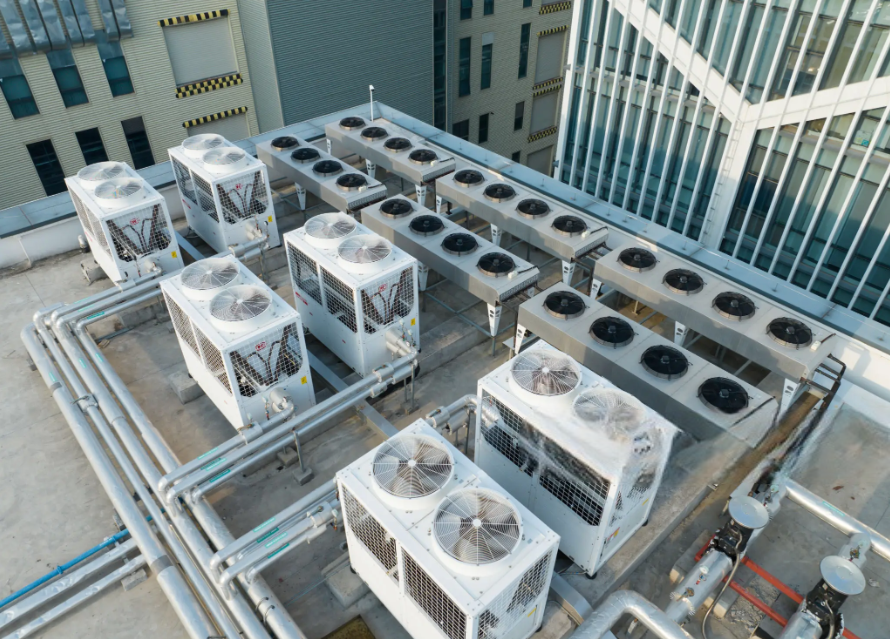
Air quality and temperature in a factory, warehouse or commercial space are not comfort details. They are technical parameters with direct impact on productivity, product quality, energy consumption and compliance with health and safety regulations.
A correctly sized industrial HVAC system maintains temperature and humidity within the limits required by the production process, ensures air quality for employees and equipment, controls differential pressure between zones with different requirements and operates efficiently throughout the lifetime of the facility. An undersized, oversized or incorrectly designed system generates additional costs every month of operation.
What Does Industrial HVAC Mean?
HVAC stands for Heating, Ventilation and Air Conditioning. In the industrial and commercial context, an HVAC system covers all functions required for controlling indoor environmental conditions: temperature, relative humidity, air quality and, in some applications, differential pressure between zones.
Unlike residential or office systems, industrial HVAC works with much larger air flow rates, high thermal loads, process-specific filtration requirements and continuous operating conditions — often 24 hours a day, 365 days a year.
Types of Industrial HVAC Systems
Industrial Ventilation Systems
Industrial ventilation ensures the replacement of stale air in production spaces with fresh air, control of pollutants and dust, evacuation of excess heat generated by processes and equipment, and maintenance of oxygen concentration at appropriate levels.
There are two main types:
General ventilation — provides uniform air replacement throughout the entire space, through fresh air supply and stale air extraction. This is the standard solution for production halls, warehouses and logistics spaces.
Local exhaust ventilation — captures pollutants, dust or heat directly at the source of generation, before they spread throughout the space. This is the solution for processes that generate point emissions — welding, mechanical processing, chemical processes, industrial furnaces.
Industrial Air Conditioning Systems
Industrial air conditioning controls both the temperature and the relative humidity of the air in the space. It is required in applications where environmental conditions directly influence product quality or the production process.
VRF systems (Variable Refrigerant Flow) — systems with variable refrigerant flow that allow independent temperature control in different zones of the same facility. They are energy-efficient, flexible and suitable for commercial spaces, offices and hotels.
Rooftop units — compact units mounted on the roof that simultaneously provide heating, cooling and ventilation for a space. They are the frequent solution for industrial halls, logistics centres and medium to large commercial spaces.
Central air handling units (AHU) — air treatment units that control temperature, humidity, filtration and air flow. They are the solution for applications with strict air quality requirements — pharmaceutical, food and electronics industries.
Heat Pumps
Heat pumps represent the modern solution for simultaneously providing heating and cooling, with superior energy efficiency compared to conventional systems. By using thermal energy from air, ground or water, heat pumps can deliver 3–5 times more thermal energy than they consume electrically.
They are indicated for commercial spaces, HORECA, offices and factories with moderate heating and cooling requirements, especially where there is interest in reducing the carbon footprint and long-term energy costs.
Industrial HVAC Applications
Production Halls and Factories
Production halls have complex and varied HVAC requirements: evacuation of heat generated by machinery, dust and pollutant control, maintenance of working temperature for employees and, in some cases, strict control of temperature and humidity for equipment protection or product quality.
Sizing an HVAC system for a production hall starts with identifying all heat sources — electric motors, furnaces, exothermic processes — and all sources of pollutants, dust or humidity. Calculating the required air flow rate and choosing the distribution system are essential for efficient operation.
Logistics Warehouses and Distribution Centres
Logistics warehouses require ventilation for temperature and humidity control, prevention of condensation on goods and ensuring working conditions for personnel and handling equipment. In temperature-controlled warehouses, the HVAC system must be integrated with the refrigeration installation for efficient control of environmental conditions.
Commercial Spaces and Retail
Supermarkets, shopping centres and food stores have specific HVAC requirements: thermal comfort for customers, compensation of the thermal load generated by open refrigeration units, ventilation of food preparation areas and air quality control in busy areas.
HORECA and Office Spaces
Restaurants, hotels and office spaces require HVAC systems that combine energy efficiency with low noise levels and individual temperature control by zone. VRF systems and heat pumps are the solutions frequently used in these applications.
Food and Pharmaceutical Industries
Food processing plants and pharmaceutical facilities have strict air quality requirements — advanced filtration, precise temperature and humidity control, differential pressure between clean zones and production zones, traceability of environmental parameters for HACCP or GMP compliance.
Technical Criteria for Choosing an Industrial HVAC System
Thermal Load and Air Flow Calculation
Any correct HVAC project starts with the thermal load calculation — all heat and cold sources in the space — and the required air flow rate for maintaining the desired conditions. A rigorous calculation prevents both oversizing, which increases initial cost and energy consumption, and undersizing, which generates inability to maintain desired parameters.
Energy Efficiency
HVAC systems are significant consumers of electrical energy in any industrial or commercial facility. Choosing equipment with high efficiency ratings, using variable speed drives on fans and compressors, recovering heat from extracted air and integrating with energy management systems are factors that significantly reduce long-term operating costs.
Air Quality and Filtration
Filtration requirements vary significantly depending on the application. A mechanical production hall requires filtration for coarse dust. A food factory requires fine filtration and, in some areas, HEPA filtration. A pharmaceutical facility requires clean rooms with advanced filtration and strict particle control. Choosing the wrong filtration class generates either unnecessary costs or non-compliance with applicable regulations.
Noise Level
In commercial spaces, HORECA and offices, the noise level of the HVAC system is an important criterion. Industrial units with high noise levels are unacceptable in these applications. The design must include acoustic attenuators, duct sound insulation and selection of equipment with noise levels appropriate to the intended use of the space.
When Do You Need This Solution?
You are building a new production hall or logistics centre and need an integrated HVAC system from the design stage
You operate a factory or commercial space with an old HVAC system that has high energy consumption or frequent operational problems
You have received notifications from health and safety authorities regarding air quality or thermal conditions in the workplace
You are expanding an existing space and the current HVAC system can no longer meet the new requirements
You want to reduce energy costs by modernising the air conditioning and ventilation system
What to Look for Before Choosing a Supplier
In-house technical design capability: thermal load calculation, air flow calculation and distribution system design require engineers specialised in HVAC, not just installers
Experience in similar applications: a supplier specialised in residential or office systems does not necessarily have the competence required for a food processing plant or industrial hall
Technical partners for equipment: air handling units, fans, Rooftop units and VRF systems from recognised manufacturers, with service available in Romania
Complete documentation: technical design, aerodynamic and thermal calculations, technical manuals, commissioning reports
Maintenance contract: HVAC systems require periodic checks and cleaning to maintain efficiency and compliance
Verifiable references: similar completed projects, with the possibility of speaking directly with end users
FAQ
1. What is the difference between ventilation and air conditioning?
Ventilation ensures the replacement of stale air with fresh air and the removal of pollutants, without necessarily controlling temperature. Air conditioning simultaneously controls temperature, humidity and air quality. A complete HVAC system integrates both functions, plus heating, into a coordinated assembly.
2. How much energy does an industrial HVAC system consume?
Consumption depends on the size of the space, the external design temperature, the indoor temperature requirements and the type of equipment. As a reference, a 2,000 sqm industrial hall can consume between 80,000 and 200,000 kWh per year for HVAC, depending on these factors. Systems with variable speed drives and heat recovery can reduce consumption by 30–50%.
3. What is a VRF system and when is it recommended?
VRF (Variable Refrigerant Flow) is an air conditioning system with variable refrigerant flow that allows independent temperature control in different zones of the same facility with a single external unit. It is recommended for commercial spaces, hotels, offices and buildings with multiple zones with different temperature requirements.
4. Is periodic maintenance of an HVAC system mandatory?
Yes, both from an energy efficiency perspective and from the perspective of compliance with health and safety regulations. Clogged filters, dirty heat exchangers and worn components reduce system efficiency and can generate poor indoor air quality. Maintenance frequency depends on the type of system and operating conditions.
5. How long does the design and execution of an industrial HVAC system take?
For medium-sized systems — halls up to 2,000 sqm — the typical timeframe is 6–10 weeks from firm order. Complex systems for processing plants, large commercial buildings or applications with special air quality requirements require 3–6 months.
Do you need an industrial HVAC system correctly designed for your facility? The InterFrig Group team analyses your specific technical requirements, calculates the thermal load and air flow rate and recommends the optimal solution — from industrial ventilation to VRF systems and heat pumps.