
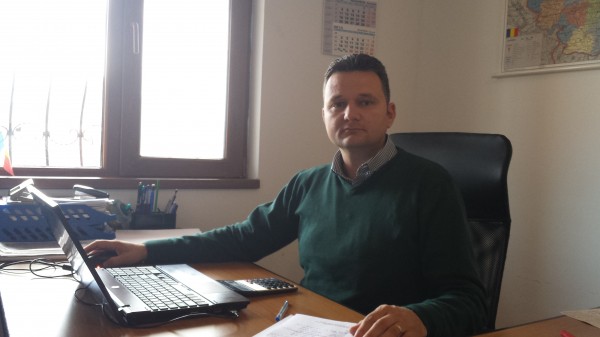
How did the company start and what was the initial vision?
We started in 2005 in Constanța with entirely Romanian capital and a clear conviction: that in the refrigeration industry, quality of execution and honesty toward the client are the only things that matter in the long run. We didn't start with significant resources. We started with technical expertise, good people, and the principle that profit is not an end in itself — only when accompanied by respect: for the client, for the project, for the craft.
The initial vision was to build a company capable of delivering complete solutions in industrial refrigeration — not just selling equipment, but designing, supplying, and installing refrigeration and ventilation/air conditioning systems, as well as related elements such as insulated enclosures, systems that extend shelf life and product quality (controlled atmosphere systems, humidification systems), and even food processing equipment. In short: a solutions integrator.
What were the most important milestones in the company's development over these 20+ years?
The first major milestone was consolidating technical competence. Industrial refrigeration does not forgive improvisation — a poorly designed cold room or an undersized compressor generates problems the client pays for years. So we invested consistently in people and in relationships with equipment suppliers — Friga-Bohn, Bitzer, Frascold, Trane, Emerson, Samsung, and other partners who gave us access to European-level technology.
The second milestone was diversification. We started with commercial refrigeration for supermarkets and food stores and gradually evolved toward industrial refrigeration in the food sector, slaughterhouses and processing plants, industrial HVAC and ventilation for production facilities, and thermal comfort systems for commercial spaces, restaurants, hotels, and offices. Each new segment required us to grow technically.
The third milestone, which we are still living through, is adapting to an increasingly complex environment: stricter European legislation on refrigerants, rising energy efficiency requirements, more informed clients with higher expectations. This is not a comfortable context, but it is one in which serious companies have a clear advantage over those that have operated at the minimum acceptable standard.
How has the refrigeration industry in Romania changed since you started?
It has changed fundamentally. In 2005, the market was dominated by cheap equipment, improvised installations, and a lowest-price culture. Clients asked how much it cost first and — if they asked at all — how it worked second.
Today things have changed, not completely, but significantly. European legislation on high-GWP refrigerants has eliminated some of the cheap, underperforming solutions from the market. Energy costs have radically shifted profitability calculations — a client who ten years ago could ignore the energy efficiency of an installation can no longer afford to. And food safety standards, required by retailers and veterinary authorities, have raised the bar for all suppliers.
What hasn't changed enough is the culture of preventive maintenance. Too many operators still intervene only when the installation stops — not before. It's a costly mentality that the market will correct over time.
INTERFRIG GROUP offers complete solutions, from design to maintenance. How important is it for clients to work with an all-in-one partner?
It's essential — and I say that not as a sales argument, but as a technical observation. A refrigeration installation is a system. Every component — insulation, compressor unit, evaporator, automation, cold room doors — operates in interdependence with the others. When design, installation, and service are handled by different actors, each with their own logic, grey areas of responsibility inevitably appear. When something serious breaks down, no one is responsible for anything.
When a single supplier takes on the entire chain — from thermal load calculation to the preventive maintenance contract — there is clear accountability and technical consistency throughout the installation's lifetime. For a client who depends on continuous operation — a slaughterhouse, a logistics warehouse, a supermarket chain — this consistency is not a luxury; it is an operational necessity.
How do you see 2026 for the refrigeration and HVAC industry in Romania?
2026 is a year with good momentum, but real pressures. On one hand, investment in industrial and logistics construction continues — new halls, warehouses, distribution centers, factories — and every new project generates demand for refrigeration and HVAC. The food sector remains active, retail is expanding and modernizing in small and medium-sized cities, and food processors are investing in new capacity or upgrading existing facilities.
On the other hand, the forced transition away from high-GWP refrigerants toward newer alternatives — R448A, R449A, CO₂ transcritical — generates additional project costs and requires technical competencies that not all suppliers have. This is an opportunity for companies that have invested in technical training and a problem for those that haven't.
What are the biggest challenges you see in the market right now — costs, workforce, legislation, sustainability?
Qualified labor is, without question, the most acute problem. Refrigeration engineering is a trade learned over years, not months. A good technician who understands both the mechanical side of an installation and its automation and fault diagnosis is extremely difficult to find and even harder to train. Vocational education in the field has been underperforming in Romania for a long time, and the consequences are visible in the market now. Our company has developed partnerships with certified service and installation teams that allow us to cover the entire national market geographically.
Material costs have remained volatile compared to the pre-2020 period, making it difficult to quote for projects with long lead times. European legislation on refrigerants is becoming increasingly restrictive and requires investment in recovery equipment, additional certifications, and more complex working procedures.
Sustainability is no longer a PR topic — it is becoming a real requirement, both from regulators and from clients with emissions reduction commitments. Refrigeration installations are significant consumers of electrical energy, and the pressure to reduce specific consumption is real and growing.
Do you feel there is a shift in mindset among clients regarding energy efficiency and sustainable solutions?
Yes, and the shift is faster than I expected a few years ago. The main driver is not ecological awareness — it's the energy bill. When electricity costs rose significantly, the profitability calculation changed radically. A client who a few years ago chose the compressor with the lowest purchase price today is interested in specific consumption, energy performance coefficients, and heat recovery solutions.
We increasingly see requests for variable-speed systems — inverters on compressors and fans — that adapt the installation's output to the actual thermal load and reduce energy consumption by 20–40% compared to conventional systems. We see interest in energy monitoring and management systems that provide concrete data on installation consumption and allow operational optimization.
This shift is good for the industry, good for clients, and good for the environment.
Are there technologies you consider underutilized in Romania right now?
Yes — for example, continuous remote monitoring of refrigeration installations. Data on warehouse temperature, circuit pressures, energy consumption, and component status are available in real time and allow preventive intervention before a minor issue becomes a major failure. Companies that adopt this approach significantly reduce maintenance costs and almost entirely eliminate the risk of product loss due to undetected faults. Adoption in Romania is still low relative to the potential.
You work with very different industries — from food processing and logistics warehouses to retail and HORECA. Is there a type of client or project that brings the most interesting challenges?
Projects for slaughterhouses and processing plants are technically the most complex. The requirements are simultaneous and sometimes contradictory: different temperatures in adjacent zones, rigorous installation hygiene, continuous operation with no possibility of extended planned downtime, compliance with veterinary and HACCP standards, and a fixed technological flow that cannot be adapted to the installer's convenience.
These projects do not forgive improvisation and do not allow easy later adjustments. They must be designed correctly from the start — equipment placement, installation routing, cooling capacities by zone, defrost systems. When a project like this comes together well, the satisfaction is proportionate to the effort invested.
A distinct segment is HORECA — restaurants, hotels, large-scale catering operations. Here the challenge is different: spaces are often unconventional, execution timelines are compressed, and aesthetic and noise requirements are added on top of the technical ones. These are projects that test a team's flexibility, not just its technical competence.
How important is response speed and the service side in a business like yours?
It's defining. A failed refrigeration installation — in a slaughterhouse, a logistics warehouse, or a supermarket — is not an inconvenience; it's an emergency with direct costs that grow with every hour of downtime. Products degrade, production stops, and commitments to clients cannot be honored.
A refrigeration supplier that lacks the capacity to intervene quickly in the event of a breakdown is not a real partner — it's an equipment seller. We have built rapid intervention capacity as an integral part of our service through partnerships with service teams covering all regions of the country — not as an add-on option. The preventive maintenance contracts we offer are not just a recurring revenue stream for us — they are the tool by which we reduce the probability that the client ever reaches an emergency situation.
What advice would you give to an entrepreneur or a young engineer looking to enter this industry?
To a young engineer I would say: invest in genuine technical competence before anything else. Refrigeration engineering is a discipline where practical experience is irreducible — no course or book substitutes for the hours spent beside an installation, diagnosing, understanding, solving problems. Seek out good people to work with, not necessarily large companies.
To an entrepreneur looking to enter the field I would say the same thing that over 20 years of experience has confirmed: cheap solutions and equipment actually increase costs and reduce profitability. A refrigeration installation executed correctly, with quality equipment and complete documentation, costs more at acquisition — but it returns the client's investment within a few years through lower energy consumption, less costly maintenance, and a longer service life. And for the contractor, it allows the commercial margin to be preserved, since there are no callbacks, interventions, or warranty component replacements. An installation executed at minimum cost generates problems from the first year, with cumulative costs that quickly exceed the initial commercial margin.
What are INTERFRIG GROUP's major objectives for the coming years?
We are focused on three directions.
The first is consolidating technical capacity for new technologies — particularly CO₂ transcritical systems and installations with advanced energy management. The market is moving in this direction and we want to be ready to meet demand before it becomes urgent.
The second is expanding our portfolio of preventive maintenance contracts and turnkey refrigeration installations for new clients in the food, processing, and logistics industries. This is the direction where we see the most room for growth and, at the same time, where we can deliver the most concrete long-term value to our clients.
The third is continued sectoral diversification — industrial HVAC for production halls and logistics warehouses is a segment with growing demand, which we approach with the same integrated methodology we have applied in refrigeration: design, execution, service, complete accountability to the client.
We are a Romanian company, built over 20 years with patience and technical standards we have never compromised in order to win one more project. That remains the foundation on which we continue to build.
More information about our services and projects can be found at interfrig-group.ro.
In what geographic areas does INTERFRIG GROUP operate and what types of projects do you work on most frequently?
INTERFRIG GROUP operates nationally, with completed projects throughout the country — Moldova, Muntenia, Transylvania, Dobrogea, and the Black Sea coast. We have executed turnkey refrigeration installations and cold storage facilities for clients in Bucharest and the surrounding area, the Moldova region, Transylvania, and the south of the country. There is no geographic limitation on the projects we take on, as long as their technical complexity and scale justify our full involvement.
In terms of typology, we work across a wide range: cold storage facilities for the food industry, cold rooms for processors of meat, fish, and dairy, complete installations for slaughterhouses, equipping supermarkets and food stores with refrigerated display cases and central refrigeration units, HVAC systems for industrial halls and production facilities, and heat pump climate systems for commercial spaces, HORECA, and offices. Projects range in size from a few dozen square meters to warehouses of several thousand square meters or processing plants with complex technical requirements. The common criterion is not size, but the need for a correctly designed and professionally executed solution.
Do you also work with designers and architects who integrate refrigeration or HVAC solutions into new construction projects?
Yes, and this collaboration is one of the most valuable for both parties. An industrial or commercial construction project that integrates refrigeration or HVAC requirements from the design phase is always better executed and more efficient than one where the installation is conceived after the structure is already built.
When we collaborate with a design office from the concept phase, we can influence the placement of technical spaces, the sizing of penetrations for installation routing, the thermal load the structure must support, and maintenance access. All of these seem like details in the design phase and become costly problems if ignored.
We are always available to provide technical assistance to designers working on projects that will include turnkey refrigeration installations or industrial HVAC systems — because a well-conceived project from the start is in everyone's interest: the designer's, the contractor's, and the end beneficiary's.
What does the first stage of working with INTERFRIG GROUP actually look like — what should an entrepreneur or designer know before contacting you?
The first conversation doesn't need to be an exhaustive technical discussion. We need a few basic pieces of information to respond usefully: the intended use of the space and the type of products that will be stored or processed, the approximate floor area and clear height, the required working temperature or temperatures, and, if they already exist, the architectural plans of the facility.
With this information we can conduct an initial technical assessment and provide a rough cost estimate that allows the entrepreneur or investor to validate project feasibility before going into detail. We don't require a perfect brief — we know that in many cases the client comes to us precisely because they don't know exactly what they need and are looking for a technical partner to help clarify requirements.
The next step is a site visit or a technical meeting, after which we deliver a detailed proposal with the recommended solution, specified equipment, costs, and execution timelines. From first contact to proposal, our objective is to be clear, fast, and not waste anyone's time.